I spend most of my time writing about films from a bygone era. The people who lived through the 1980s and 90s remember them fondly—nostalgia is a powerful drug. But what about today's audiences? The ones who weren't alive when these films hit cinemas?
Do these movies still work? Or are they museum pieces propped up by sentiment?
For 2026, I wanted to start a new series that strips away the rose-tinted glasses and asks a simple question: does this film survive on its own merits, or does it need a degree in cultural context just to understand why it mattered?
I'm starting with Dad (1989), a film that feels like the ultimate analogue heart-tugger from a world that moved at a different speed entirely.
The Amblin Touch Nobody Talks About
Dad was produced by Steven Spielberg's Amblin Entertainment during its imperial phase—the same factory churning out Back to the Future Part II, Always, and Indiana Jones and the Last Crusade. But whilst those films got posters on bedroom walls, Dad became a footnote.
Director Gary David Goldberg came from television (Family Ties) and brought that small-screen intimacy to a theatrical release. The result was a $20 million film that made $28 million domestically—respectable, but not exactly Field of Dreams numbers.
What nobody expected was how it would age.
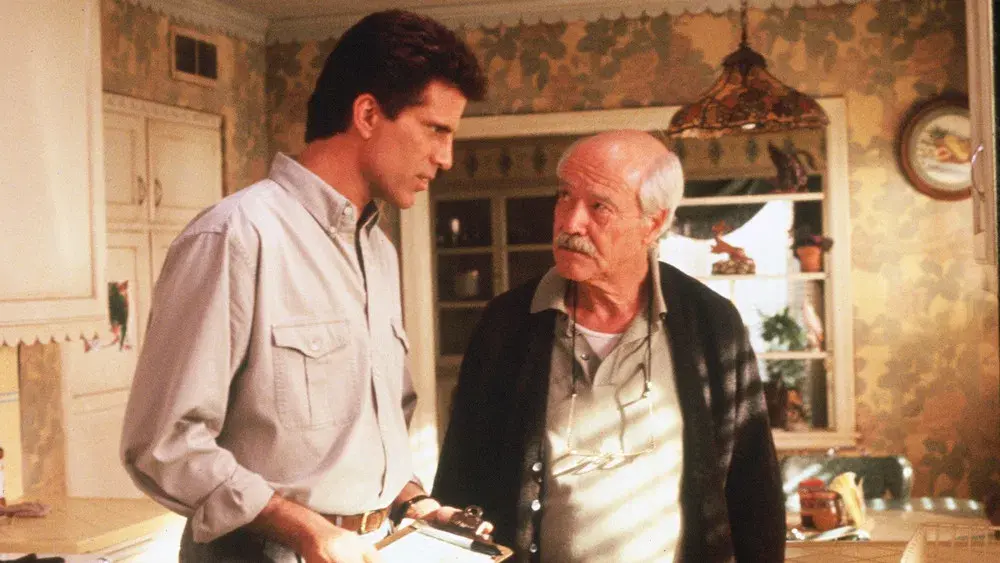
Released during the twilight of the Reagan era, Dad stars Jack Lemmon as Jake Tremont, a man who has spent decades being "managed" by his overbearing wife Bette (Olympia Dukakis). When she suffers a heart attack, his workaholic son John (Ted Danson) flies in to help—and discovers that his father has essentially forgotten how to live.
The film was dismissed as Oscar-bait melodrama. Critics called it manipulative. Variety said it "overplays the sentiment."
Watching it from the vantage point of 2026 feels like peering through a window into a world where time moved differently. And I'm not entirely convinced the critics were right.
The "Hardware" of 1989: Life Without the Tether
The first thing you notice in 2026 is the clutter of the past.
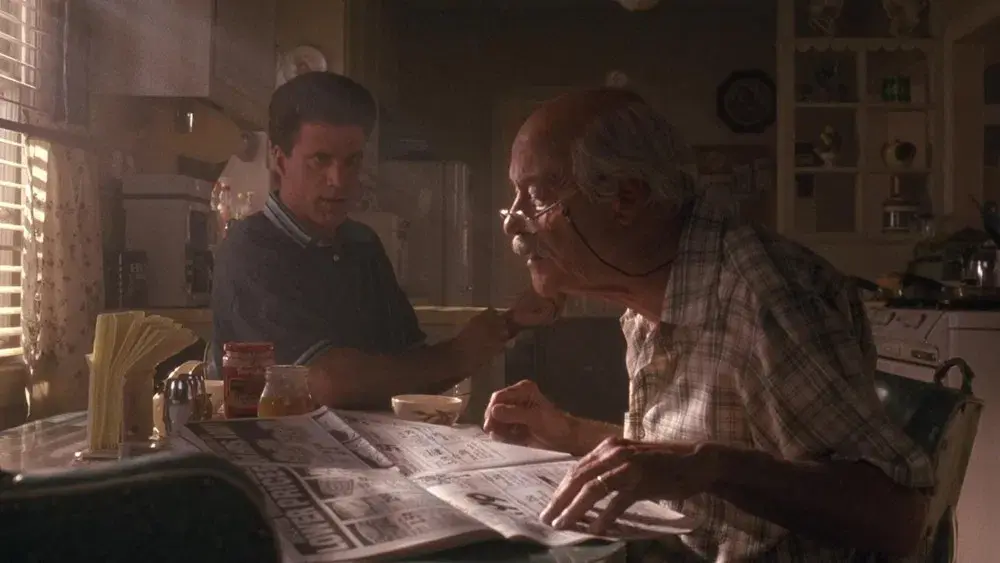
This is a world of beige landlines with tangled cords, bulky Chrysler LeBarons, and the sheer quiet of a house without a single screen glowing in the dark. There's no ambient hum of notifications. No phantom vibrations. Just silence.
Ted Danson's John Tremont is a high-flying financier, which in 1989 meant having a physical stack of pink "While You Were Out" slips on your desk. Today, his "stressful" lifestyle looks like a luxury retreat.
When he goes home to care for his father, he is effectively off the grid. There is no Slack backchannel with the office. No FaceTime check-ins with his kids. No GPS guiding him to the hospital. This isolation creates a specific type of intimacy that we've traded for 24/7 connectivity.
And honestly? It makes the film work better now than it did then.
Jack Lemmon's Masterclass in Vulnerability
Let's be clear: Jack Lemmon is doing heavyweight lifting here.
At 64 years old, playing a man who has been infantilised by his own marriage, Lemmon brings layers to what could have been a one-note "confused old man" performance. When John discovers that Jake doesn't know how to make breakfast, pay bills, or even shave properly, the film could tip into condescension.
It doesn't. Because Lemmon plays Jake not as helpless, but as dormant—a man who was capable once, but who traded autonomy for peace.
There's a scene early in the film where John teaches his father how to shave. It's shot in real-time, no music, just the sound of running water and a safety razor scraping across stubble. Lemmon's face registers confusion, then concentration, then something close to pride.
That scene still hits like a freight train in 2026.
It's the kind of patient, unshowy acting that modern cinema has largely abandoned. No quips. No self-awareness. Just a man learning to be himself again.
The Pacing: A Feature, Not a Bug
Critics in 1989 often called Dad "slow." In 2026, after years of frantic TikTok-paced editing, the film feels like a digital detox.
It's a 117-minute movie that actually allows a scene to breathe. We watch John teach his father how to do laundry. We watch them sit in a hospital waiting room without cutting away every three seconds. We watch Jake hesitate before answering a simple question.
Modern Hollywood is so rushed that it rarely lets a story develop organically. Everything has to happen. Characters can't just be.
Dad refuses to hurry. And that refusal is the point.
This was an era when movies were allowed to take their time because the audience wasn't distracted by a second screen in their pockets. The "slowness" isn't a failure of pacing—it's patient cinema.
The Ethan Hawke Audition Story Nobody Mentions
Here's something nobody mentions: a teenage Ethan Hawke plays John's son Billy, and he's genuinely excellent.
But the story of how he got the role is even better.
Whilst filming Dead Poets Society, Hawke and several of his castmates—including Robert Sean Leonard and Gale Hansen—all auditioned for roles in Dad. They travelled to New York together by train and filmed the entire journey. (I'll be adding that footage below—it's a time capsule of young actors on the verge of stardom, completely unaware of what's coming.)
Hawke was 18 years old, still figuring out what kind of actor he wanted to be. This was before Reality Bites, before he became the patron saint of Gen-X introspection. In 1989, he was just a kid with good instincts.
His scenes with Lemmon have a surprising tenderness. There's a moment where Billy sits with his grandfather in the hospital and asks him what it was like being young. Jake can't remember. The look Hawke gives him—half pity, half fear—is pure early-career instinct.
It's a reminder that Dad was a training ground for future heavyweights.
Where the Film Stumbles: The Cancer Plot
And then the film takes a hard left turn into pure 1980s melodrama.
Midway through, Jake is diagnosed with cancer. Except the film never shows us the test results. We never see the tumour. A doctor simply tells him he has cancer, and Jake immediately goes into a coma of despair.
It's medically nonsensical and emotionally manipulative in a way that feels cheap. The entire third act becomes a race against time to "wake up" Jake with the power of love and baseball.
Look, I understand what the film is trying to do. It wants to create urgency. It wants to force John into a reckoning with his own priorities. But it does so by turning Jake into a metaphor rather than a person.
The cancer plot is where Dad loses its grip on reality and becomes the Oscar-bait weepie the critics accused it of being.
The "Shrewish Wife" Trope That Hasn't Aged Well
Let's talk about Olympia Dukakis as Bette.
She's supposed to be the antagonist—the overbearing wife who turned her husband into a dependent child. The film makes it clear that Bette micromanaged every aspect of Jake's life, from his meals to his friendships.
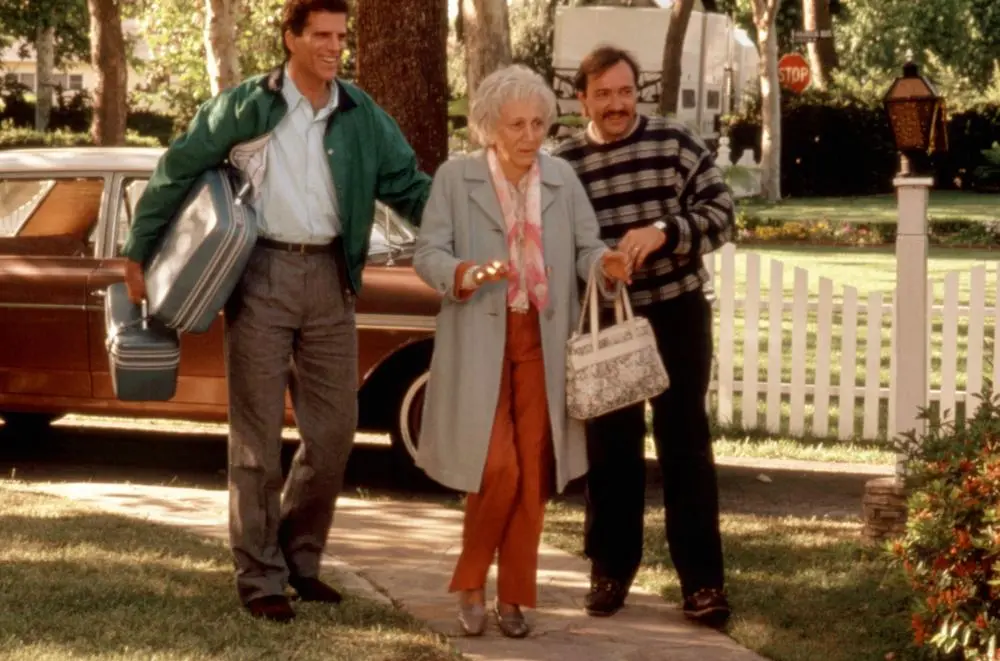
But the film never interrogates why. Was Jake unreliable? Was he neglectful? Did she take control because he abdicated responsibility?
We don't know. And the film doesn't seem interested in asking.
Instead, Bette becomes a one-dimensional "nag" who exists solely to be proven wrong. When she recovers and sees her husband living independently, she's meant to realise the error of her ways.
It's a trope that was already tired in 1989. In 2026, it feels downright antiquated.
The Father-Son Dynamic: Still the Beating Heart
But strip away the melodrama and the dated gender politics, and you're left with something undeniably powerful: a film about the sandwich generation.
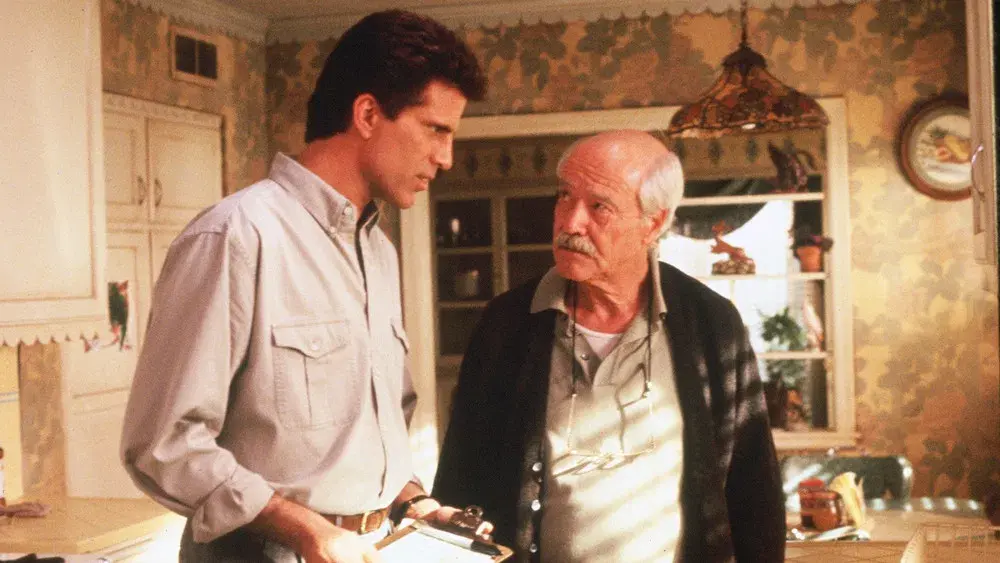
John is caught between caring for his ageing father and raising his own children. He's exhausted. He's resentful. He's terrified of becoming Jake—a man who sleepwalked through his own life.
The scenes where John sits with his father and realises how little he actually knows about him are quietly devastating. Jake can't remember where he met Bette. He can't remember his own son's childhood.
This isn't just about dementia or ageing. It's about the accumulated absence of presence.
And in 2026, when "being present" has become a wellness cliché sold on Instagram, Dad offers something more honest: the brutal difficulty of actually showing up.
Read Next
From the Vault
Does the "Analogue Heart" Still Beat?
So does Dad hold up for someone watching it in 2026 with no nostalgic attachment to 1989?
Here's the surprising answer: its emotional core—the struggle of caring for ageing parents whilst managing your own life—is more relevant now than it was in 1989.
We live in an era where adult children are moving back in with parents to afford rent. Where long-term care is financially ruinous. Where the sandwich generation is being squeezed harder than ever.
Its central question—how do you help someone reclaim their life without losing your own?—is timeless.
The Verdict: Does Dad Survive 2026?
Dad is not a perfect film. It's manipulative. It's sentimental. It has a third act that collapses into pure fantasy.
But it also has Jack Lemmon delivering one of his finest late-career performances. It has patient, confident filmmaking that refuses to pander to short attention spans. And it has a young Ethan Hawke reminding us that before he became a generational icon, he was just a kid trying to understand his grandfather.
Would a Gen-Z audience raised on Marvel films and TikTok pacing connect with it? Probably not. The cancer plot is too contrived. The pacing would frustrate anyone expecting constant stimulation.
But on emotional honesty? On the strength of Lemmon's performance? On the simple, radical act of letting a scene play out without cutting away?
Yeah. It survives.
In 2026, Dad is a time capsule. But it's also a mirror—one that asks uncomfortable questions about how we care for the people who raised us, and whether we're brave enough to truly see them.
How Do We Score It Then?