
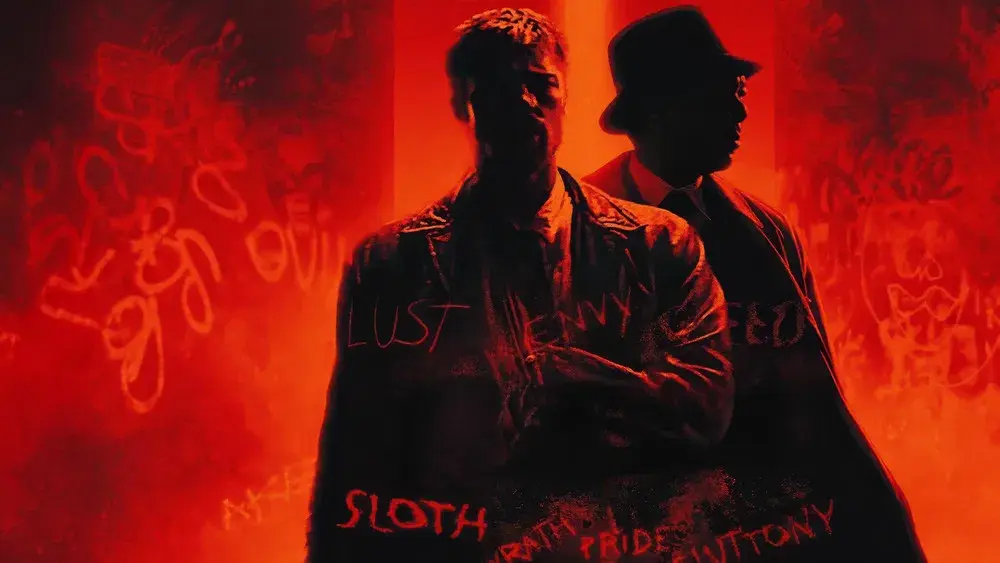
Nameless City, 1995. Rain-slicked streets. A nameless terror stalking the concrete canyons, leaving corpses as moral lessons. Two detectives—one jaded, counting days until retirement; the other hungry, convinced justice still means something—descend into a darkness that will consume them both. The city itself becomes a character, all grime and shadow and relentless rain, washing nothing clean.
The ending still shocks. It shocked then; it shocks now. Three decades haven't dulled it—if anything, time has sharpened the blade. When the lights came up in theatres that September, audiences sat in stunned silence. Some walked out. Most stayed, processing what they'd witnessed. A serial killer film that became something else entirely. A meditation on evil that refused easy answers.
This was Se7en—David Fincher's grim masterpiece that rescued his career, saved Brad Pitt's, and launched a thousand imitators. Released on 22nd September 1995, it cost $33 million and returned $327 million. More importantly, it entered the cultural bloodstream. "What's in the box?" became instant shorthand. The title sequence revolutionised graphic design in film. And the cast? They scattered into wildly divergent futures—Oscar wins and business empires, scandal and disgrace, steady working lives and quiet deaths. Thirty years later, their trajectories tell us everything about Hollywood's cruelty and its occasional grace. This remains one of my favourite films, so I have a bit more to say than usual!
The Lead Trio
Brad Pitt (Detective David Mills) — The Star Who Almost Wasn't
THEN: 31 years old, and professionally wounded. Pitt had exploded in Interview with the Vampire (1994), but the aftermath left him raw. "The most unhealthy time of my life," he'd later admit—paralysed by sudden fame, unsure whether he was an actor or a commodity. When Se7en came along, he fought for it. New Line wanted a bigger name; Pitt campaigned relentlessly. He even injured his arm during the apocalyptic finale, the bone breaking mid-scene, and Fincher kept rolling. That chaos fuelled Mills's desperation—an actor and character both running on fumes and fury.
Pitt's chemistry with Gwyneth Paltrow, who played his on-screen wife Tracy, bled into reality. They began dating during production. Hollywood's newest golden couple, forged in Fincher's gloom. The romance would last three years, surviving Se7en's press tour but fracturing under the weight of two ascending careers.
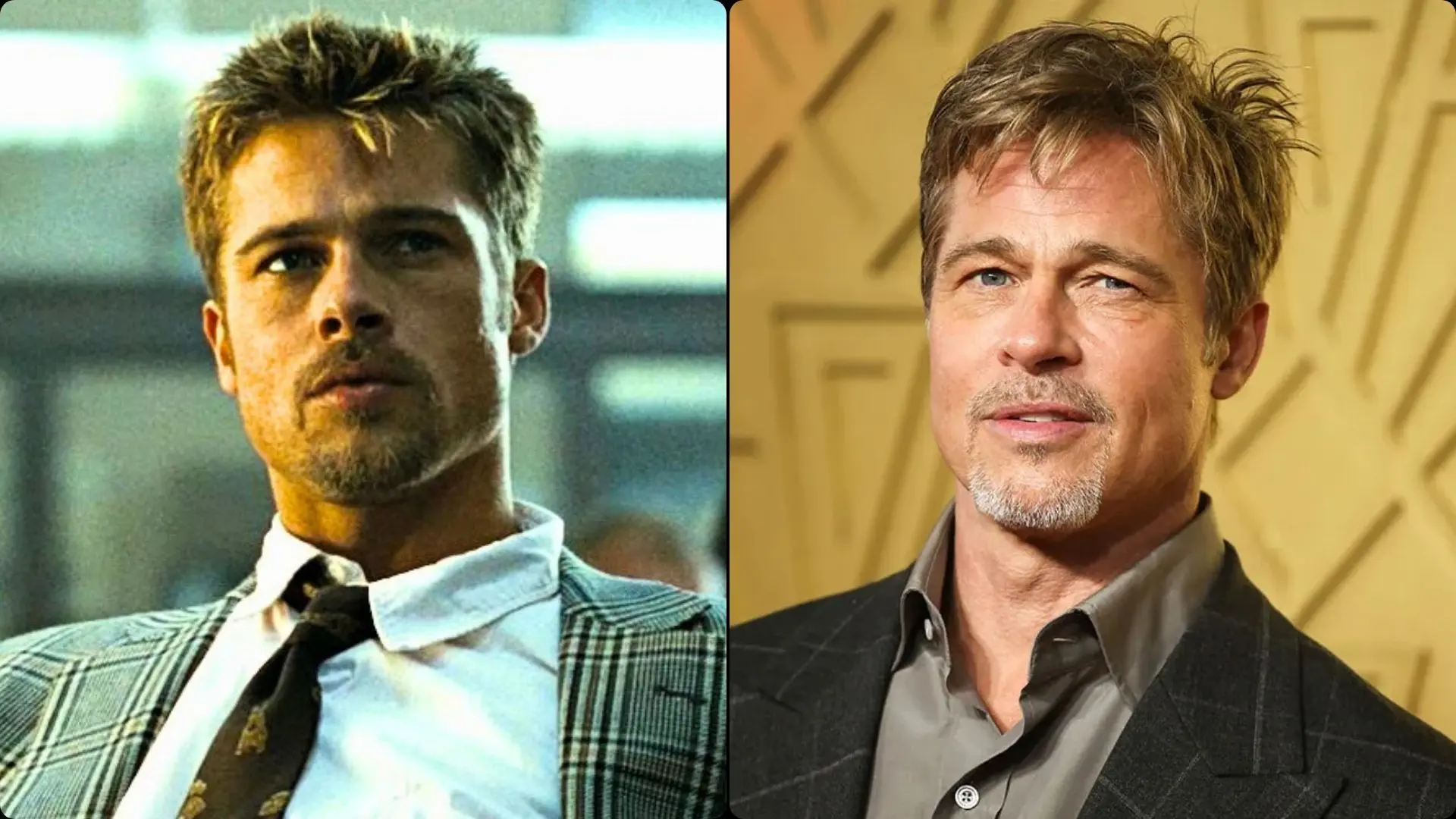
NOW: 62, and arguably the last true movie star. Pitt won his acting Oscar for Once Upon a Time in Hollywood (2019), finally silencing those who'd dismissed him as just a pretty face. But it's his producing work that reveals his evolution—Plan B Entertainment has shepherded 12 Years a Slave, Moonlight, and Women Talking to Best Picture wins. He's become Hollywood's sophisticated elder statesman, recently racing Ferraris in F1 (2025) and producing thoughtful cinema that out-earns his early blockbusters.
The irony? Pitt credits Se7en with saving him. "I just got the Jones back," he told Parade in 2025—that hunger, that purpose. Without Fincher's faith, without Mills's desperation, would we have the Pitt of The Tree of Life, Moneyball, Ad Astra? Thirty years on, he's the film's biggest success story—and its most grateful survivor.
The Arm That Wouldn't Heal
During the chase scene where Mills pursues John Doe through rain-slicked streets, Pitt jumped from a moving car and shattered his left arm on impact. He finished filming that day in agony. The injury required surgery and months of rehabilitation. Fincher later admitted he'd have stopped production if he'd known the severity—but Pitt's insistence on continuing shaped Mills' increasingly frayed physicality in the film's final act.
Morgan Freeman (Detective William Somerset) — The King of Dignity
THEN: 57, and already an institution. Post-Shawshank Redemption (1994), Freeman commanded respect simply by entering the frame. Variety called his Se7en performance "supremely nuanced"—the weary intellectual whose faith in humanity expires scene by scene. Somerset could have been a cliché—the older cop handing wisdom to the rookie—but Freeman embroidered him with such specific sorrow, such intellectual exhaustion, that he became archetype.
This was Freeman cementing his template: the mentor, the narrator, the moral compass that still spins true even when everything else breaks. He'd played versions before; he'd play versions for decades after. But Somerset remains his darkest iteration—a man who reads The Canterbury Tales at crime scenes, who recognises the killer's genius because he shares his despair.
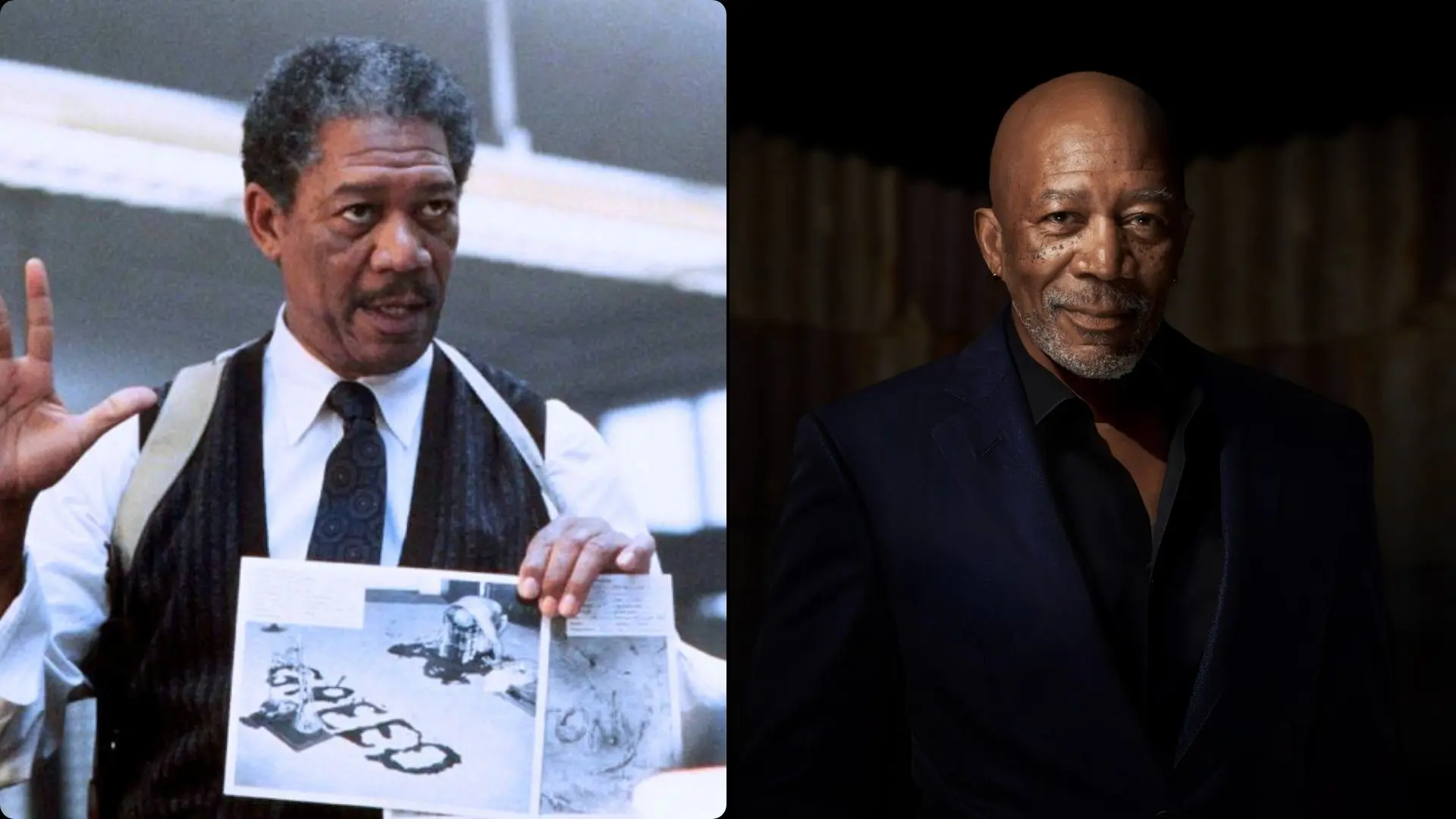
NOW: 88, and working still. Freeman collected his Oscar for Million Dollar Baby (2004), played God twice (Bruce Almighty, Evan Almighty), anchored Christopher Nolan's Dark Knight trilogy as Lucius Fox, and became America's voice—literally, narrating everything from March of the Penguins to Visa commercials. In 2023, he starred in Lioness; in 2025, Now You See Me 3.
Age has slowed him physically—public appearances require walking sticks—but the voice remains untouched, that honeyed authority that makes even exposition sound like revelation. Freeman represents Hollywood's best bargain: competence, professionalism, and an absence of scandal across six decades. In an industry that devours its elders, he's become permanent architecture.
The Title That Almost Wasn't
The film was originally titled Seven. New Line Cinema worried audiences would confuse it with the 1993 thriller Seven. Fincher insisted on keeping the numeral '7' in marketing to evoke biblical weight. The compromise? Official title: Se7en. That single stylised character became iconic—proving that sometimes the smallest creative decisions echo loudest.
Kevin Spacey (John Doe) — The Monster We Made
THEN: 35, and terrifying. Spacey insisted on remaining uncredited in trailers and posters, preserving the twist that he'd dominate the film's final act. It worked—audiences didn't recognise him until the 90-minute mark, when he emerged from that taxi, blood-soaked and serene. This was the same year he'd won an Oscar for The Usual Suspects; 1995 made him the most exciting actor in American cinema.
His John Doe is still studied in acting classes: the soft voice, the biblical certainty, the utter absence of madness in a madman's eyes. Spacey understood that true fanaticism looks like calm. He made evil seductive, almost reasonable—which is precisely why the performance disturbs. We like Doe before we abhor him. That was Spacey's gift, and eventually, his curse.
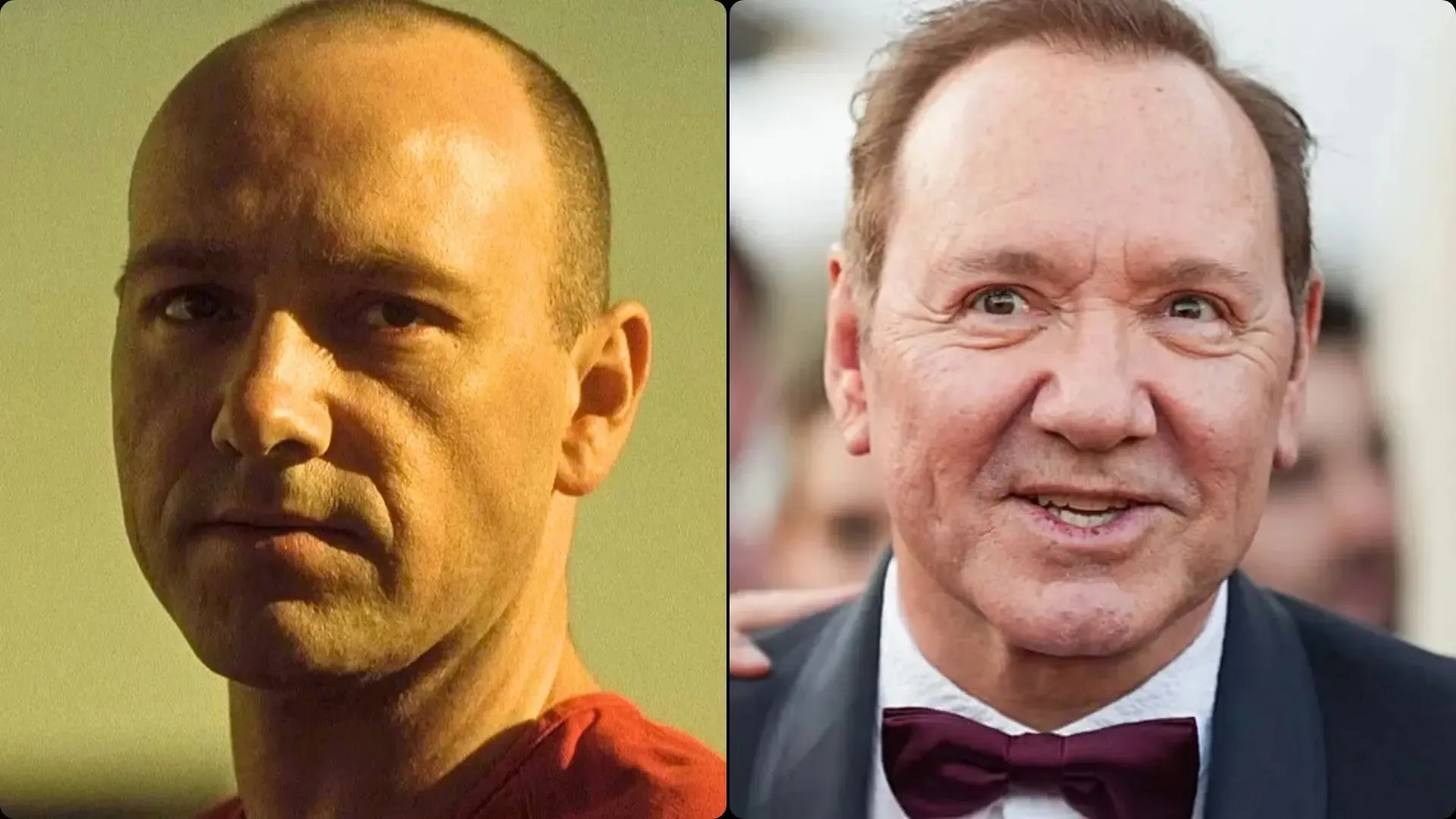
NOW: 66, and radioactive. The allegations of 2017—sexual misconduct, harassment, assault—halted his career mid-stride. House of Cards fired him; All the Money in the World replaced him; the industry that had feted him at the 2000 Oscars (American Beauty) turned away. Spacey has denied criminal wrongdoing but admitted to "drunken behaviour." The courts delivered mixed verdicts—acquittals in some trials, civil judgments in others—but Hollywood's court of opinion proved harsher.
He has attempted resurrection: indie films like Peter Five Eight (2024), a bizarre Christmas video as Frank Underwood, interviews portraying himself as victim. The audience isn't buying. Spacey's trajectory offers the starkest contrast in this ensemble—potential eternal greatness reduced to cautionary tale. Whether his work survives him remains an open question. Se7en doesn't require defending, but watching it now carries baggage that Freeman and Pitt escaped. Doe's monologues about sin and punishment feel queasily prophetic, art and artist merged in uncomfortable ways.
The Supporting Cast
Gwyneth Paltrow (Tracy Mills) — The Pivot Queen
THEN: 22, and luminous. Paltrow had Jane Austen's Emma (1996) coming next, then Shakespeare in Love (1998) and an Oscar. But in Se7en, she's essentially plot device—the wife who humanises Mills, whose fate delivers the final blow. Paltrow knew it. She played Tracy's warmth efficiently, trusting Fincher to do the rest.
Her romance with Pitt generated tabloid heat. They were beautiful together, serious together, attending premieres in matching haircuts. When they split in 1997, it was civilised, almost too civilised—two ascending stars recognising that merged gravity would collapse both orbits.
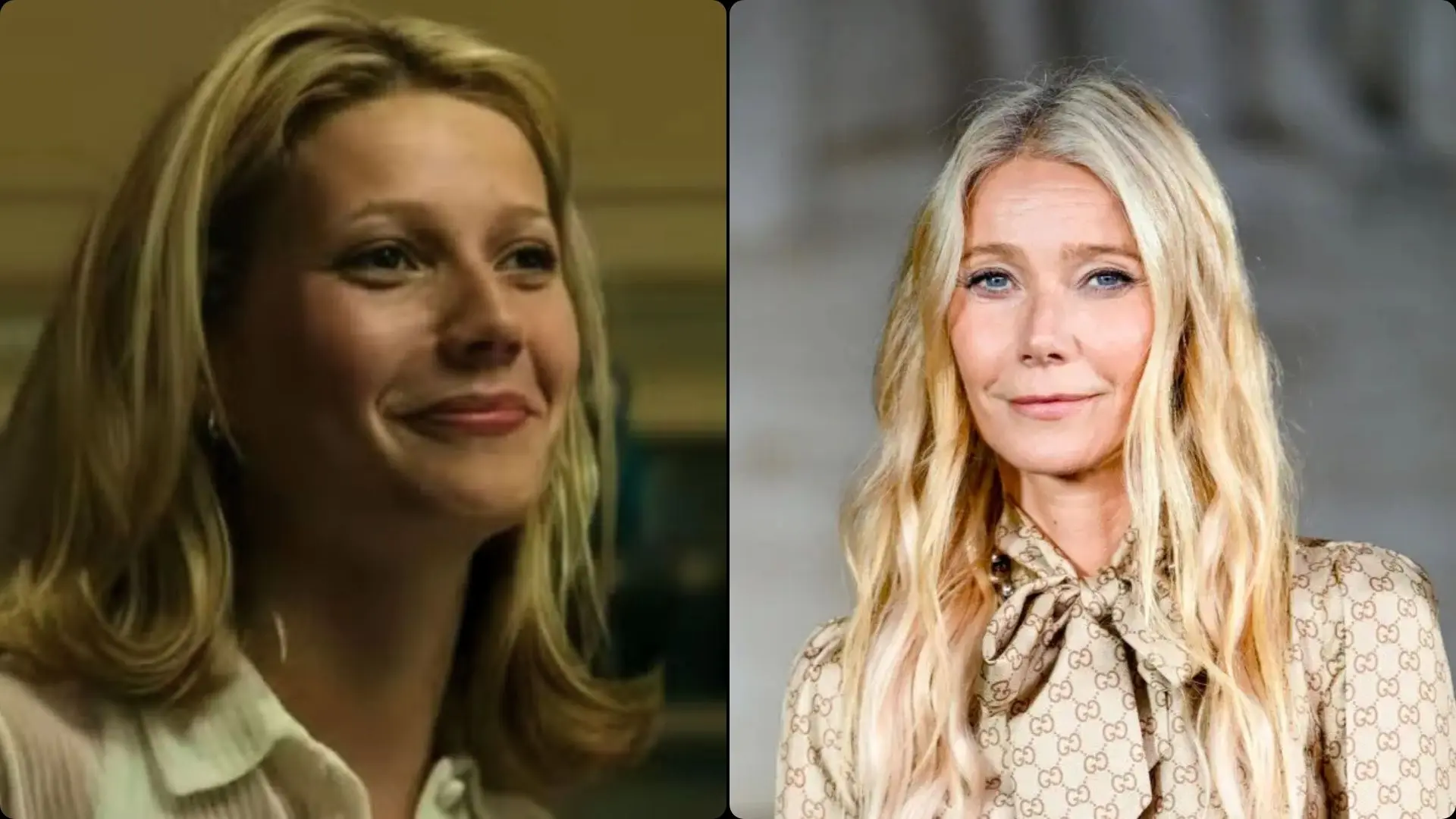
NOW: 53, and transformed from that ingénue. Yes, she became Pepper Potts in the Marvel Cinematic Universe (2008-2019), earning millions and generational recognition. But Paltrow's real story is the pivot—abandoning acting's precarity for entrepreneurship's control. Goop, launched in 2008, became a wellness empire worth $250 million, then supposedly less, then more, depending on which funding round you believe.
She's been mocked for vaginal eggs and conscious uncoupling, celebrated for destigmatising female sexuality, analysed as case study in celebrity capitalism. What she hasn't been, lately, is an actress. Marty Supreme (2025) marks a return of sorts, but Paltrow's choice fascinates more than her comeback. While Pitt chased artistic legitimacy and Freeman simply worked, Paltrow built a fortress against Hollywood's whims. Tracy Mills died in a box; Gwyneth Paltrow escaped the box entirely.
The Box That Almost Wasn't
New Line Cinema executives demanded a rewritten ending where Mills' wife survives. Fincher threatened to quit. Screenwriter Andrew Kevin Walker had already quit once over studio notes. Only when Brad Pitt personally lobbied the studio—arguing the dark ending was the entire point—did executives relent. That single creative stand preserved one of cinema's most devastating final acts.
R. Lee Ermey (Police Captain) — The Authentic Voice
THEN: 50, and already iconic. Ermey brought genuine Marine Corps authority to Se7en—16 years after Full Metal Jacket made him the screen's definitive drill instructor. His Captain is pure procedural backbone, the bureaucrat who enables the hunt without romanticising it. Ermey didn't act military; he was military, and it showed in every barked order, every weary tolerance of Mills's impatience.
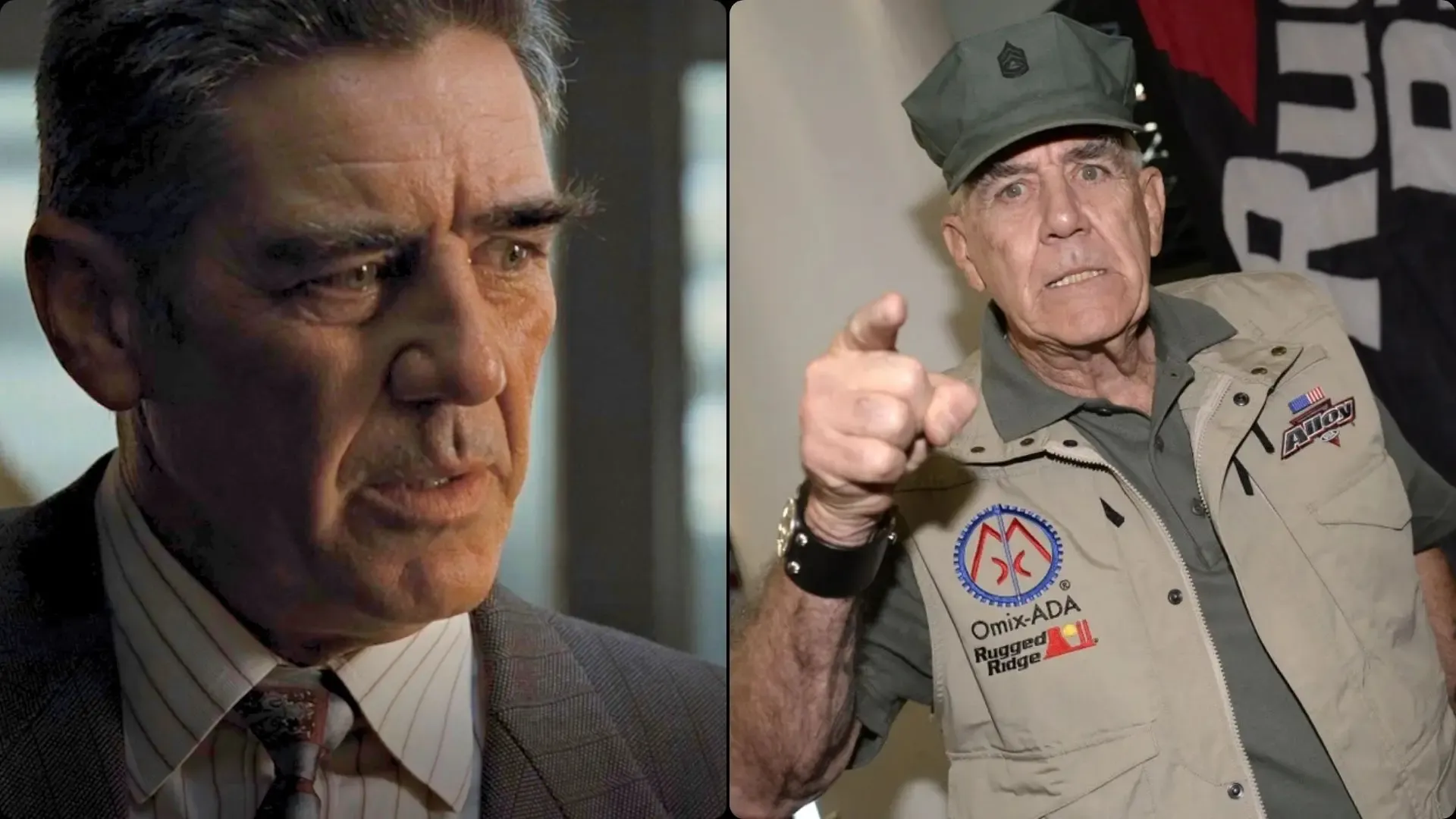
NOW: Deceased, 15th April 2018, aged 74. Pneumonia complications ended a career built on typecasting embraced rather than escaped. Ermey voiced Sarge in three Toy Story films, hosted Mail Call and Lock n' Load for the History Channel, and played variations on his drill sergeant persona until the end. He never apologised for the narrowness of his range; he expanded the range's depth instead.
His death marked the passing of a specific Hollywood species—the non-actor who became essential through authenticity. Ermey didn't study at RADA or Yale. He served in Vietnam, survived wounds, and brought that survival to every role. The industry has no replacement ready.
Read Next
From the Vault
John C. McGinley (SWAT Leader California) — The Character Actor's Victory
THEN: 35, and solid. Post-Platoon (1986), McGinley had built a career as reliable supporting muscle—intense eyes, compressed rage, the guy who follows orders with suspicious competence. His SWAT leader in Se7en gets minutes of screen time but crucial ones, bookending the investigation with professional violence.
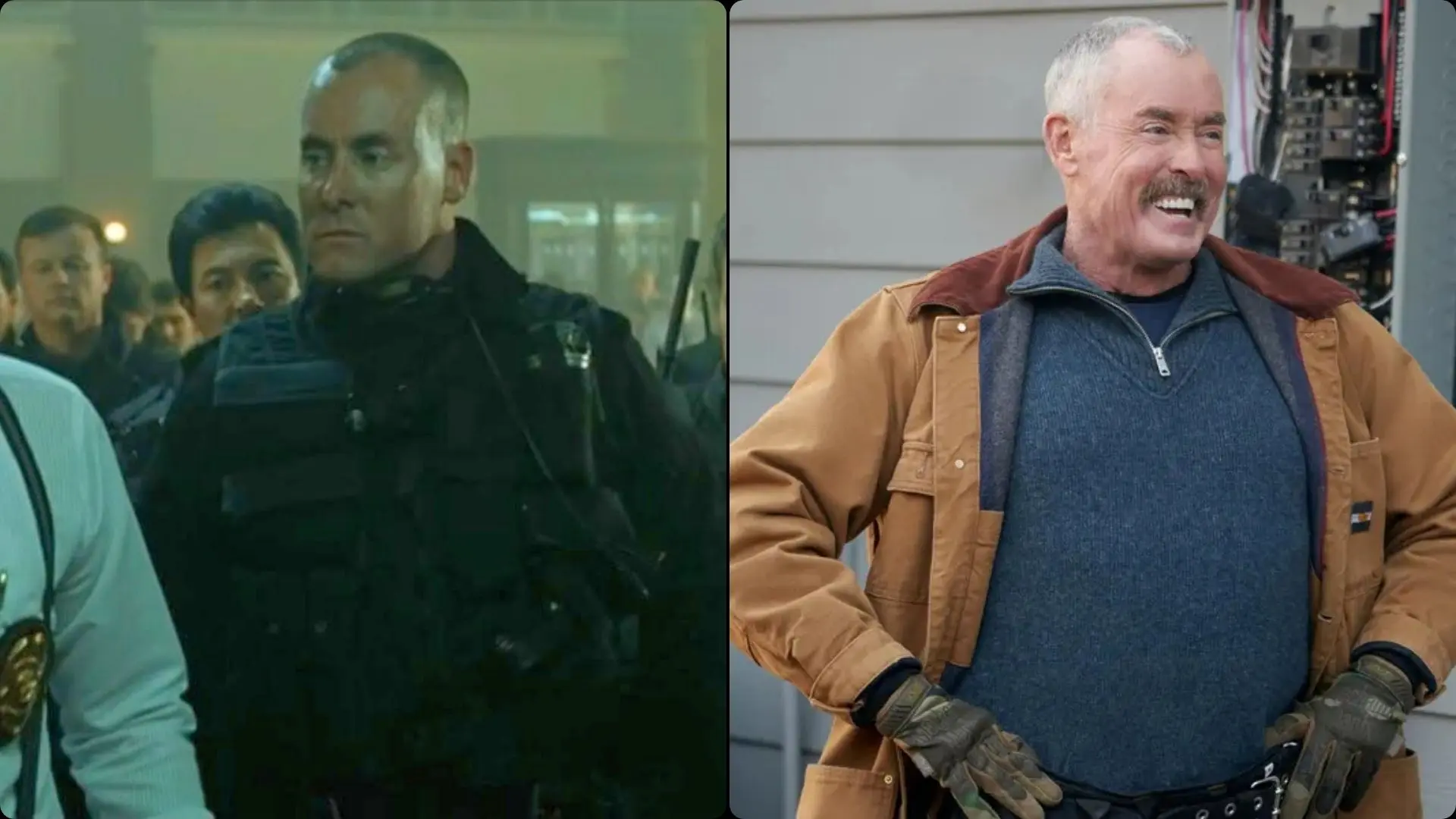
NOW: 66, and beloved. Scrubs (2001-2009) transformed him from "that intense guy" to Dr. Perry Cox, the misanthropic mentor whose rants became YouTube scripture. Nine seasons of television dominance, then voice work (Stanley), then a return to procedural heavies in Chicago P.D. and Brooklyn Nine-Nine.
McGinley represents the working actor's dream—not stardom's lottery, but consistent employment across four decades. He's married, raising a son with Down's syndrome, advocating for special needs causes. No scandals, no pivots, no flameouts. Just craft, persistence, and the wisdom to recognise when a TV comedy script offered more longevity than thriller villainy.
Richard Roundtree (District Attorney Martin Talbot) — The Pioneer
THEN: 53, and carrying history. Shaft (1971) had made him the face of blaxploitation, the black private detective who was "a sex machine to all the chicks." By 1995, that revolution had become nostalgia; Roundtree took character roles—authoritative, brief, reminders of a cinema that challenged while entertaining.
His Talbot appears in exactly two scenes, negotiating the politics of the investigation. Roundtree dignifies them with presence, suggesting entire off-screen bureaucratic wars.
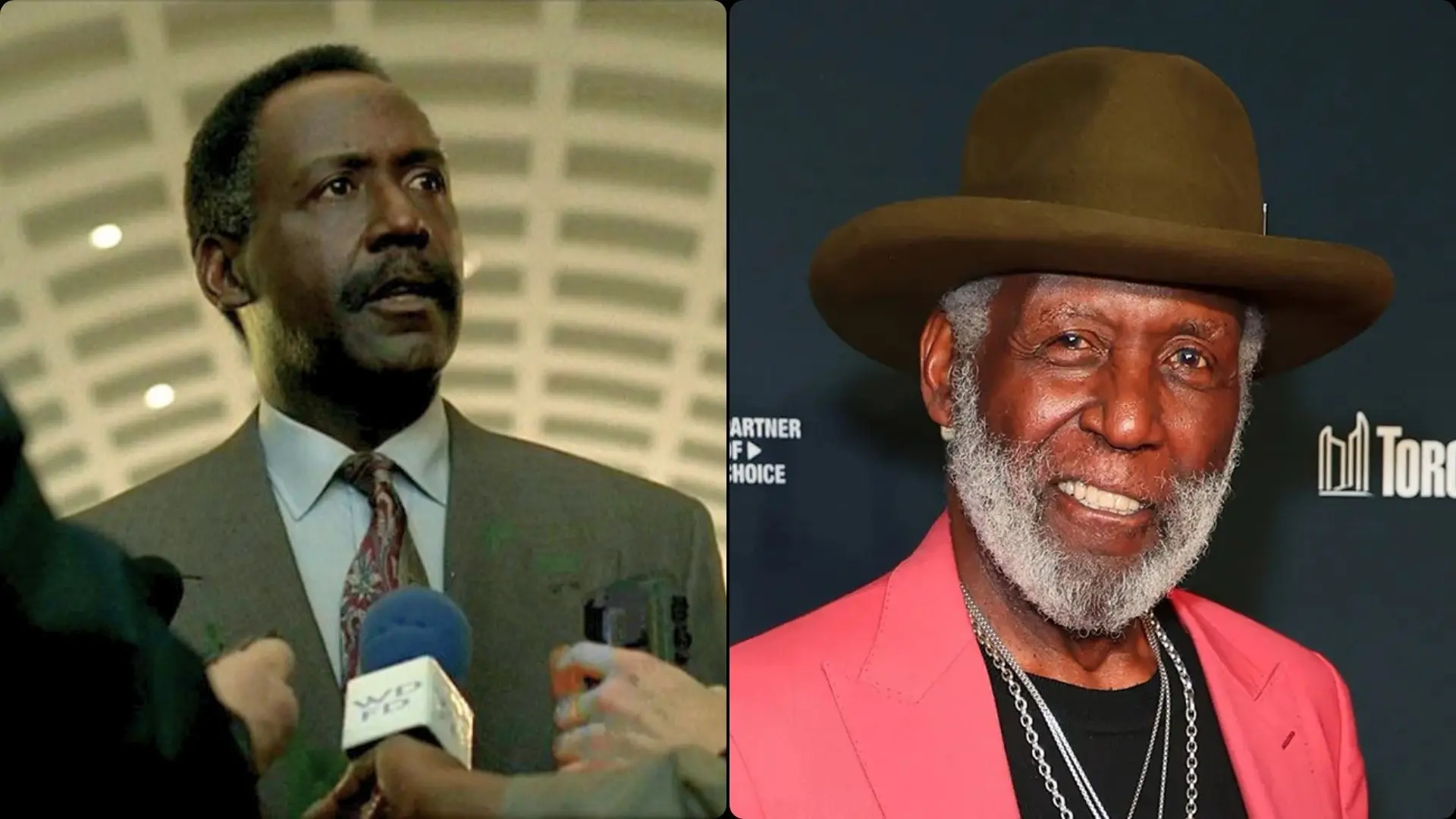
NOW: Deceased, 24th October 2023, aged 81. Pancreatic cancer. Roundtree worked until the end—Being Mary Jane, Family Reunion, the Shaft reboot (2019) where he passed the torch to Samuel L. Jackson and Jessie T. Usher. His legacy extends beyond filmography; he proved that black action heroes could anchor franchises, that exploitation could empower, that cool transcends era.
When he died, tributes noted the diagnosis had come just two months prior—typical Roundtree, working through pain without announcement. The pioneer never stops marching.
Love Cast Then vs Now Comparisons?
Explore our collection of movie cast transformations through the years. From their first appearances to today, witness how your favorite actors have changed over the decades.
View More Cast Comparisons →Hawthorne James (George, Library Guard) — The Bit Part
THEN: 44, and memorable for seconds. James's library guard appears once, threatening Somerset with expulsion until the detective reveals his badge. The scene exists to establish information-gathering; James gives it friction, suspicion, the city's default hostility to outsiders.
NOW: 75, and largely retired. Credits thinned after 2010—occasional voice work, convention appearances for Speed (1994) enthusiasts where he played "Mac" McMahon. His is the typical trajectory of the working class actor: decades of employment, then the gradual fade as casting directors seek fresher faces for identical roles.
James isn't tragic; he's complete. He played the game, collected his wages, and stepped back. Not every career demands a third act.
Reg E. Cathey (Dr. Santiago) — The Coroner
Then: In his early 30s, Reg E. Cathey brought gravitas to the coroner Dr. Santiago, examining the sins' victims with clinical detachment. Known for stage work, this role highlighted his deep voice and presence amid 90s TV gigs.
Now: Cathey passed away on the 9th February 2018 at 59 from lung cancer. Post-Se7en, he shone in The Wire and won an Emmy for House of Cards (2015). His legacy is one of understated power, a voice that elevated every project.
Film Fact: Casting Curiosities
- Kevin Spacey went uncredited to hide his twist role.
- Brad Pitt and Gwyneth Paltrow's on-set romance lasted two years.
- The writer, Andrew Kevin Walker, cameo'd as the first victim's corpse.
Other Notable Faces
Se7en featured cameos and bits that stuck with viewers.
Leland Orser (Crazed Man in Massage Parlor) — The Traumatised Witness
Then: Orser, in his 30s, played the unhinged survivor of the lust murder, a scene-stealing moment of hysteria.
Now: At 65, he's thrived in TV like I Am the Night and films like Taken. Steady work defines his path.
Daniel Zacapa (Detective Taylor) — The Steady Hand
Then: 41, with fifteen years of TV guest spots behind him—The Waltons, Falcon Crest, Murder, She Wrote. The Latino character actor cast for authenticity without star power.
Now: 71, and still grinding. Chicago Fire, Bosch, The Bridge—Zacapa is the definition of "that guy." No awards, no headlines. Just auditions, bookings, repeat.
Richard Schiff (Mark Swarr) — The Lawyer
Then: Schiff portrayed Victor's sleazy attorney, a brief but slimy turn.
Now: Aged 70, he's best known as Toby in The West Wing, with recent roles in The Good Doctor.
The Themes They Carry
Se7en at 30: The Autopsy of an Era
The 2025 4K restoration isn't a nostalgia trip; it’s a crime scene. It's proof of a lost Hollywood—where studios gambled $33 million on shadows and directors fought for endings that didn't just linger, but scarred.
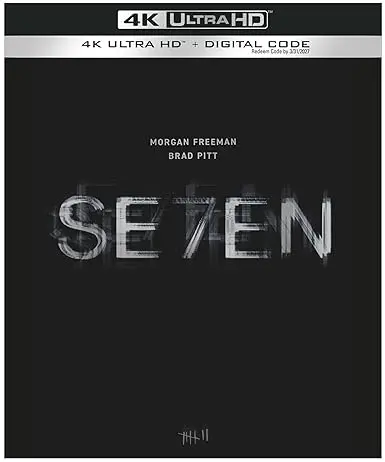
Seven (4K Ultra HD + Digital)
- This is an affiliate link and we may earn small commission
Look at them in 1995. Brad Pitt, shedding his "pretty boy" skin for something jagged. Morgan Freeman, cinematic granite. Kevin Spacey, a shark circling his apex. This wasn't just casting; it was a prophecy.
The Industry’s Seven Sins
The film didn't just depict collapse; it scripted the cast’s future. The trades became the sequel:
- Pride: The hubris that genius grants immunity (Spacey).
- Greed: Fame converted into lifestyle commerce (Paltrow).
- Wrath: The scorched-earth fury of a falling idol.
- Gluttony: The franchise-feeding frenzy that consumed a generation.
- Sloth: The quiet retirement of the legends who walked away (James).
- Lust/Envy: Our voyeuristic hunger for the ruin.
The Box Stays Open
Spacey’s disgrace forces a brutal question: Can you separate the masterpiece from the monster? The rain offers no answers.
Fincher’s city wasn't a victim; it was an accomplice. Today, the "systemic rot" has simply migrated to the cloud. We build gods to feast on their descent, refreshing the feed and calling it "justice."
We are still in that car. The frantic detective, the weary veteran, the killer who knows the destination. We drive toward the horror, convinced that this time we’ll save the innocent. We never do.
The box has been open for thirty years. We’ve always already looked inside.