Right. Let's get something out of the way immediately: this is going to be nostalgic, sentimental, and possibly insufferable to anyone who thinks Falling for Christmas is peak cinema. I'm about to spend 3,000 words arguing that Christmas films peaked between 1984 and 1999, and I'm going to do it while wearing a ridiculous jumper and drinking something that's essentially liquid Christmas in a mug—I think there's cinnamon and egg and milk involved, possibly some regret, definitely too much nutmeg.
But if you want to understand why my children—born in the 2010s with zero personal connection to the 1990s—have watched Home Alone seventeen times and can't remember a single Netflix Christmas film they've seen, then pour yourself a mulled wine and settle in.
We're going on a sleigh ride through the Golden Era of Christmas cinema. And yes, I'm calling it the Golden Era. Unapologetically.
[Takes a sip of eggnog]
The Kids Choose Home Alone (Every Single Time)
My children were born in 2012 and 2014. They have no nostalgia for 1990. They never experienced the Berlin Wall falling, they've never seen a Blockbuster Video, and they think Friends is "that old show Mum watches."
Yet when I offer them a choice between Netflix's latest Christmas release and Home Alone, they choose Home Alone. Every. Single. Time.
They've watched it seventeen times. They quote it at dinner. They REQUEST it specifically. When the paint can hits Marv, they've started predicting his scream before it happens.
When your 12-year-old asks to watch a film from 1990 instead of something made last month, you start asking questions. Specifically: what did those films have that makes them stick?
The answer isn't just nostalgia. My kids never experienced the 90s. They're responding to something else entirely. So let's talk about the Golden Era: 1984 to 1999. Fifteen years when Christmas films actually mattered.
They Feel Real (Even When They're About Evil Gremlins)
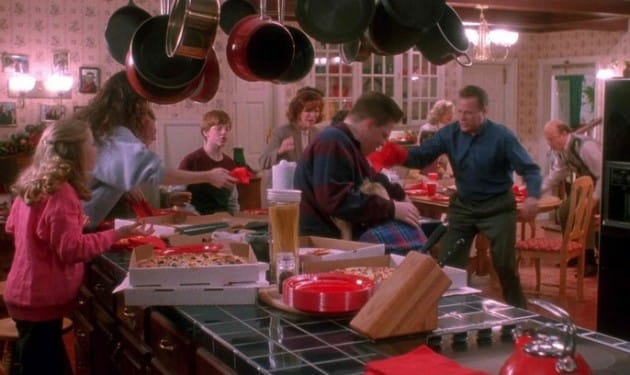
Picture this: Christmas Eve, 1990, the McCallister house. This isn't a set from Architectural Digest. It's genuine chaos. Too many people, too much luggage, too much stress, everyone talking over each other, milk spilling, pizzas arriving wrong, tickets being miscounted.
Kate McCallister isn't quirky-lovable. She's absolutely frantic. Peter McCallister snaps at his children. Uncle Frank is openly hostile. Buzz is a legitimate bully who deserves everything Kevin dishes out.
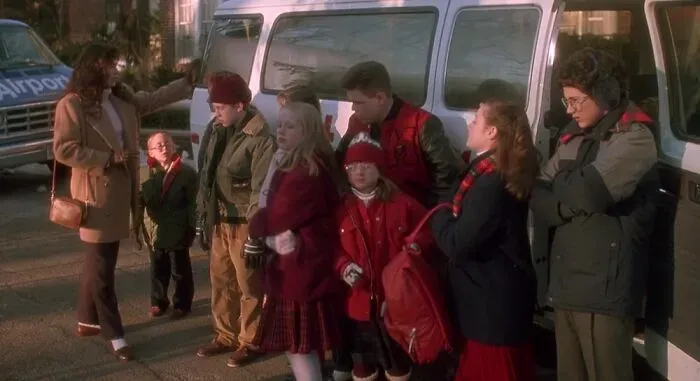
When Kevin gets left behind, it's not because of whimsical Christmas magic or a cute misunderstanding. It's because his family is drowning in normal human chaos—power cuts, broken alarm clocks, headcounts done wrong, panic compounding panic.
My kids recognise that immediately. They've watched me forget something critical while packing. They've seen family holidays descend into barely-controlled pandemonium. Home Alone doesn't feel like a film. It feels like Tuesday.
[Refills mug. This stuff is quite good actually.]
National Lampoon's Christmas Vacation takes it further. The Griswolds don't just have charming quirks—they actively resent each other. Clark's Christmas bonus anxiety is genuine financial desperation. He's not being silly; he NEEDS that money. He's already spent it. The in-laws are genuinely dreadful. Nobody's having a good time until the very end, and even then it's barely held together.
The Ref pushes it into pure dysfunction. Denis Leary plays a burglar who takes a married couple hostage and becomes so frustrated by their toxicity that he starts giving them marriage therapy. Kevin Spacey and Judy Davis have weaponised every grudge, every disappointment, every failure from fifteen years of marriage. This isn't cute Christmas bickering. This is genuine dysfunction that's been festering.
Even While You Were Sleeping—with one of the most absurd premises in cinema history—feels real because Sandra Bullock commits completely to the loneliness of her character. She's a token booth operator spending Christmas alone. The family she accidentally joins is genuinely chaotic and messy, not movie-perfect.
These films trusted us to recognise real family mess. And we did.
They Have Texture You Can Physically Touch
[Another sip. Is there brandy in this? There might be brandy in this.]
Home Alone's paint cans were real. Those stunts were practical. When Marv steps on the tar-covered steps and then onto the nail, that's actual physical comedy captured on film. When Daniel Stern puts his head through the dog door and encounters a tarantula, that's a real tarantula—his scream was genuine because they only told him right before filming.
Macaulay Culkin's scream when he slaps aftershave on his face? They filmed his genuine reaction. The icicle stabbing scene? Practical effects. The iron to the face? Stunt coordination and makeup, not digital smoothness.
Gremlins goes even further. Every Gremlin is a puppet built by Chris Walas and his team. When Gizmo gets wet, that's practical effects. When the Gremlins multiply, those are actual puppets operated by actual people. When they get murdered in increasingly creative ways—blender, microwave, exploding—that's real props being destroyed on camera.
You can FEEL the labour. You can sense the craft.
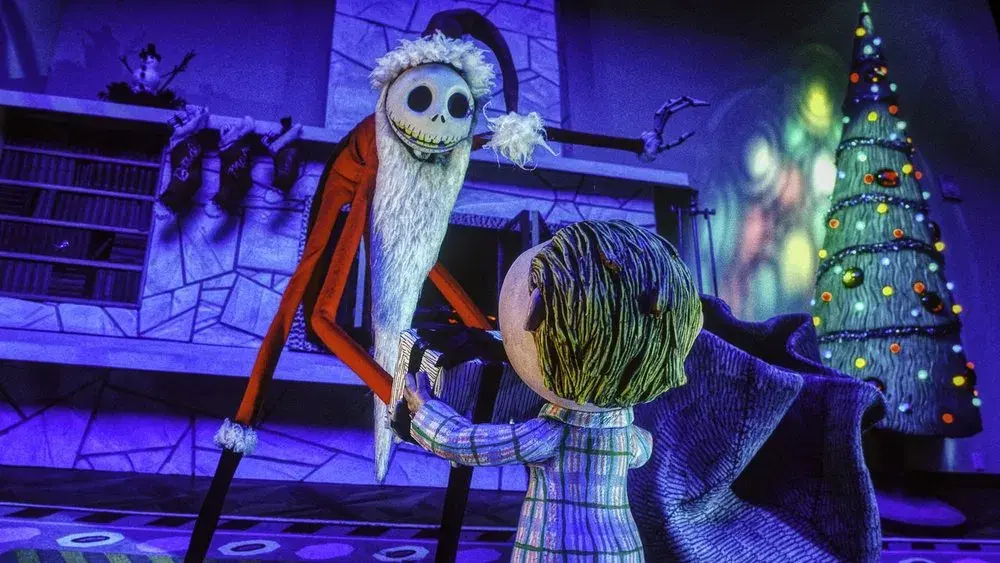
The Nightmare Before Christmas took three years of stop-motion animation. Three years of moving physical puppets frame by frame. Jack Skellington's pinstripe suit has actual texture. The snowflakes have weight. Sally's stitched-together body was built by hand.
[Tops up mug. This is definitely going down easier now.]
Jingle All the Way—look, it's not a GOOD film, let's be honest—but Arnold Schwarzenegger is actually running through actual Minneapolis streets fighting actual crowds over actual toy props. The chaos feels tangible because it WAS tangible.
Pre-digital filmmaking meant everything had to be THERE. And you can feel it in every frame.
They Trusted the Audience (Even the Kids)
Gremlins is a horror film marketed to families during Christmas 1984. The Gremlins are genuinely terrifying. They're violent, cruel, and creative in their chaos. One gets exploded in a microwave—you see it expand and burst. One gets blended alive—you see the green goo. Gizmo literally stabs one through the chest with a fountain pen.
Kate's monologue about how her father died? He dressed up as Santa, climbed down the chimney, broke his neck, and wasn't discovered until days later when he started to smell. That's DARK. That's genuinely traumatising if you think about it for five seconds.
The film trusted that kids could handle it. And we could. We loved it BECAUSE it was scary.
[This mug seems to refill itself. Magic.]
Batman Returns takes it further. The Penguin bites a man's nose OFF. Catwoman is a trauma victim who dies and comes back as a fetish-coded vigilante. Christopher Walken gets electrocuted and falls out a window. McDonald's pulled their Happy Meal tie-in because parents complained it was too disturbing.
Scrooged features Bill Murray as a genuinely suicidal television executive. He's not charmingly grumpy—he's actually cruel, broken, and dangerously close to the edge. The Ghost of Christmas Future is TERRIFYING—a faceless reaper who shows Murray his own cremation.
Even The Santa Clause—a Disney film—is about a man watching another man die, then having his body involuntarily transformed against his will. Scott Calvin's beard grows uncontrollably. He gains massive weight. He can't stop the transformation. His identity is being erased and replaced.
That's existentially terrifying if you think about it. But the film trusted kids to process it as magic while adults recognised the body horror underneath.
These films didn't patronise us. They challenged us. And we rose to it.
They're Rewatchable Because There's Depth
[How much have I drunk? The jug was full. The jug is no longer full.]
My kids have watched Home Alone seventeen times. Every rewatch, they notice something new.
The way Marv's scream changes pitch depending on what hits him. The physics of the paint cans. The fact that Kevin has an elaborate battle plan mapped out with military precision. The tarantula moment and how Daniel Stern's reaction is so committed it becomes genuinely impressive physical comedy.
Christmas Vacation is infinitely quotable. The squirrel scene plays differently every time. Clark's bonus speech gets funnier as you get older and understand financial anxiety. The physical comedy holds up because it's REAL—Chevy Chase really is falling off that ladder, diving off that sled, getting electrocuted by those lights.
Edward Scissorhands rewards multiple viewings because it's layered. The Christmas framing—the snow falling because Edward is carving ice sculptures in his castle—becomes more beautiful the more you understand the tragedy. He loved Kim. He's been creating winter for her every year since she grew old. That's heartbreaking poetry.
[Refill. Yes. Good idea.]
The Ref gets funnier on rewatch because you start catching the smaller jokes. The mother's passive-aggressive commentary. The military school son's deadpan observations. Denis Leary's increasing frustration with having to therapise his own hostages.
These films reward attention. There's always something new to discover.
Fancy something a bit weirder?
 Richard Wells
What Happened After 1999?
[Pouring another. This is research. This is JOURNALISM.]
After 1999, something shifted fundamentally. Digital filmmaking became standard. Focus groups became mandatory. Algorithms started making creative decisions.
And Christmas films became CONTENT.
Netflix releases approximately 47 identical Christmas films every November. You know the formula: career woman from the city returns to her small hometown / meets a prince in disguise / discovers a magical bakery / must save the town's Christmas festival. She meets a ruggedly handsome man with a tragic backstory. There's a misunderstanding in Act 2. Everything resolves perfectly in 90 minutes.
[Sip. Big sip. This is definitely helping me understand Netflix's creative process.]
These films are made by algorithm. Netflix knows exactly which beats to hit, which actors to cast, which running times perform best. They're optimised for completion rates, not memorability.
Everything's digitally smoothed. The snow doesn't fall with weight—it floats algorithmically perfect. The houses aren't real—they're green-screen backdrops. Even the chaos is choreographed to feel safe and controlled.
Nobody's ever in real danger. The stakes are always "will Christmas spirit be saved?" Never "will anyone actually have to change or confront something difficult?"
[I've lost track of how many I've had. Is that bad? It's fine. Everything's fine. Where's my mug?]
Everyone lives in houses that look like they're permanently staged for property viewings. The biggest problem is "will the bakery save the town's Christmas festival?" Nobody has real financial stress. Dysfunction is quirky, not genuine.
They're designed to be consumed once. Built to hit these emotional beats at these timestamps, include these required moments, resolve in exactly 90 minutes. There's no depth to discover because there was never depth built in.
Films became safe. Smooth. Weightless. Algorithm-optimised content designed for background viewing while you scroll your phone.
And kids can FEEL the difference. When something is made with craft, with care, with real human emotion and actual stakes, they respond. When something is algorithmically generated to hit predetermined emotional beats, they get bored and ask if they can go play Minecraft instead.
Before You Accuse Me of Being a Total Curmudgeon...
[Deep breath. Focus. You can do this.]
Look. It's not ALL terrible. I'm not COMPLETELY stuck in the past.
A handful of modern films prove it's still possible. Klaus (2019) brought back hand-drawn animation and had genuine heart—a story about how kindness becomes tradition. A Boy Called Christmas (2021) had that old-fashioned storybook charm—proper adventure, real stakes, Maggie Smith narrating with warmth. My kids genuinely loved it. Red One (2024) with Dwayne Johnson and J.K. Simmons understood that Christmas action films can work if you commit to the madness. The Holdovers (2023) trusted us with real mess and broken people—a boarding school teacher, a troubled student, a grieving cook, none of them getting easy resolutions. Even Ted Lasso's Christmas episode (2020) captured that old magic with warmth, genuine emotion, and actual stakes.
These exceptions prove it's not IMPOSSIBLE. Filmmakers just WON'T. Because it's safer to churn out 47 identical films that people consume once than to make one film that actually matters.
[Where was I? Right. The bad stuff is over. Now the good stuff.]
So yeah. Not everything modern is rubbish. But the exceptions prove the rule.
The Verdict: They're Not Nostalgic, They're Right
[Okay so I might be slightly drunk. But I'm DEFINITELY right.]
My kids will forget The Christmas Chronicles by New Year's. They already have. But they're quoting Home Alone at breakfast, reenacting the Christmas Vacation squirrel scene in the garden, and asking if we can watch Gremlins.
It's not nostalgia. They weren't there. They don't remember Blockbuster or VHS tracking issues or waiting a whole year to see a film again. They just recognise something REAL when they see it.
These films—from Gremlins to The Family Man, from Die Hard to Edward Scissorhands, from Christmas Vacation to The Ref—were made by people who gave a damn. People who understood that Christmas films could be scary, dark, messy, complex, and REAL. People who trusted audiences with genuine emotion, practical craft, and actual stakes.
[Another one. For courage.]
They weren't optimised by algorithm. They weren't focus-grouped into smoothness. They weren't designed to be consumed while scrolling Instagram.
They were made to MATTER.

My kids prove this every December. They don't choose Home Alone because I've brainwashed them with nostalgia. They choose it because they recognise quality even if they can't articulate why.
So this Christmas, when Netflix serves you its 47th identical rom-com—prince in disguise, bakery in jeopardy, career woman learns to love again—remember that Home Alone is right there. The Nightmare Before Christmas is waiting. Christmas Vacation is ready whenever you are.
Choose wisely. Your kids are watching. And they're not as nostalgic as you think. They're just recognising quality.
[One more for the road]
Now if you'll excuse me, I've got a date with a VHS player, a ridiculous jumper, and this eggy-cinnamony situation that's turned out to be possibly the best decision I've made all week and also maybe I should sit down for a minute actually because the room is doing a thing and Home Alone is definitely the best Christmas film ever made and Kenneth Branagh's Frankenstein is underrated and del Toro softened the ending and Stephen Norrington is a god damn visionary who walked away from Hollywood on his own terms and we should all respect that and did I mention Home Alone because those paint cans were REAL and Marv's scream is genuinely one of the great moments in cinema history and I love my family so much and they understand quality when they see it and I've spent four years investigating forgotten actors and writing proper journalism about films that matter and actually you know what Netflix can take their algorithm and their smooth digital snow and their princes in disguise and their bakeries and I'm just going to watch Home Alone again right now actually where's the remote has anyone seen the remote why is there tinsel in my eggnog when did that get there and fundamentally the problem with modern cinema is that nobody trusts anyone anymore and Michele Carey deserved better and also this jumper is actually quite comfortable and warm and possibly I should just close my eyes for one second just one second because...
zzzzzzzzzzzzz

The Complete List of ALL Films Mentioned:
The Golden Era (1984-1999):
All i want for Christmas is an affiliate link click😊
- Gremlins (1984) - Horror comedy that trusted kids with genuine scares
- Die Hard (1988) - Marriage reconciliation through terrorism
- Scrooged (1988) - Bill Murray's suicidal redemption arc
- National Lampoon's Christmas Vacation (1989) - Real financial anxiety wrapped in physical comedy
- Home Alone (1990) - Childhood independence and family chaos as love
- Edward Scissorhands (1990) - Impossible love and eternal winter
- Batman Returns (1992) - Gothic weirdness and trauma in capes
- The Nightmare Before Christmas (1993) - Three years of stop-motion poetry
- The Ref (1994) - Marriage therapy via hostage situation
- Miracle on 34th Street (1994) - Belief vs. proof in a cynical world
- The Santa Clause (1994) - Identity death disguised as family comedy
- While You Were Sleeping (1995) - Loneliness and accidental family
- Jingle All the Way (1996) - Pre-internet shopping chaos and parental guilt
Honourable Late Entry:
- The Family Man (2000) - Roads not taken and whether success means happiness
The Modern Exceptions (Films That Prove It's Still Possible):
- Klaus (2019) - Hand-drawn animation returns with genuine heart
- Ted Lasso "Carol of the Bells" (2020) - TV episode that captured old magic
- A Boy Called Christmas (2021) - Old-fashioned storybook adventure with real stakes
- The Holdovers (2023) - Real mess and broken people, no easy resolutions
- Red One (2024) - Christmas action that commits to the madness (free with Amazon Prime currently)
[Editor's note: Richard fell asleep at his keyboard around 3am. We've left the article as-is because honestly it's better this way. The eggnog was 40% brandy. He's fine. Merry Christmas.]